
O'Sensei Hironori Otsuka
(1892–1982)
The Father of Wado-Ryu Karatedo
Wado-Ryu was founded by Hironori Otsuka, a master of Shindo Yoshin-Ryu Jujutsu before ever studying karate. His early training in jujutsu profoundly shaped the principles that would later define Wado-Ryu.
In the 1920s, Otsuka became a student of Gichin Funakoshi, the founder of Shotokan Karate. While he mastered the striking methods of Okinawan karate, Otsuka recognized an opportunity to blend these techniques with the body movement, joint manipulation, and evasive principles of jujutsu.
In 1934, he formally established Wado-Ryu (“Way of Harmony”), creating a system that prioritizes:
- Tai sabaki (body shifting and evasion)
- Blending rather than clashing
- Efficiency of movement over brute force
Wado-Ryu became officially recognized by the Japanese government in 1939, solidifying its place as one of the foundational karate styles of Japan.

The Philosophy of “Wa” (Harmony)
Unlike systems that emphasize direct opposition, Wado-Ryu is built around the concept of “Wa” — harmony. This principle is reflected in both physical technique and mindset.
Rather than meeting force with force, practitioners learn to:
- Redirect attacks
- Enter safely through angles
- Maintain control with minimal effort
This philosophy traces directly back to Otsuka’s jujutsu background and remains central to authentic Wado-Ryu training today.

Grand Master Hironori Otsuka II
Continuing the Legacy (1934–2015)
Grand Master Hironori Otsuka II (1934–2015) carried forward the legacy of Wado-Ryu Karate as the second generation successor to its founder, Grand Master Hironori Otsuka I. Born in Tokyo, Japan, he grew up immersed in the art from an early age, inheriting not only the techniques of Wado-Ryu, but the responsibility of preserving its philosophy and direction for future generations.
In keeping with the traditional model of succession, Otsuka II underwent extensive training not only in Wado-Ryu Karate, but also in complementary disciplines such as Judo, Kendo, and Iaido, strengthening his understanding of timing, distance, and body mechanics—hallmarks of Wado-Ryu’s unique approach.
Following the passing of his father in 1982, Otsuka II assumed leadership of the Wado-Ryu organization, becoming its Grand Master and guiding the art through a period of international growth. Under his leadership, Wado-Ryu expanded significantly beyond Japan, with dojos and practitioners establishing a global presence while maintaining strong ties to the art’s traditional roots.
As Grand Master, he was known for:
- Upholding the technical precision and principles established by the founder
- Supporting the international development of Wado-Ryu Karate
- Preserving the importance of Wa—harmony—in both training and leadership
- Maintaining a balance between tradition and the evolving needs of modern practitioners
Otsuka II also served as a central figure in the administration and organization of Wado-Ryu, overseeing a worldwide network of dojos and instructors. His leadership helped ensure that the art remained unified in principle, even as it spread across cultures and continents.
Beyond organizational leadership, he remained dedicated to teaching, continuing to pass on the art directly to students and instructors. His influence is still felt today through the practitioners and organizations that trace their lineage through his instruction.
Grand Master Hironori Otsuka II represents a vital link in the living tradition of Wado-Ryu—a steward of the founder’s vision and a bridge to the modern era of the art.

Shihan Cecil T. Patterson
Founder of USEWF (1925–2002)
Cecil T. Patterson stands as one of the most influential figures in the development and preservation of Wado-Ryu Karate in the United States. A direct student within the lineage of the art’s founder, Hironori Otsuka, Patterson Sensei played a pivotal role in establishing authentic Wado-Ryu outside of Japan during a time when access to traditional instruction was limited.
Through years of dedicated training, Patterson Sensei developed a deep understanding of Wado-Ryu’s unique principles—particularly its emphasis on timing, body shifting (taisabaki), and the harmonization of movement rather than brute force. His approach to teaching reflected the essence of “Wa”—not only as a technical principle, but as a way of life rooted in balance, humility, and discipline.
As a pioneer of Wado-Ryu in America, he:
- Introduced structured, traditional Wado-Ryu training to American students
- Established dojos and organizational frameworks that preserved technical integrity
- Authored instructional materials to help communicate the art more broadly
- Mentored generations of practitioners who would carry the art forward
Patterson Sensei was known not only for his technical skill, but for his presence, discipline, and unwavering standards. His teaching demanded commitment, yet it also cultivated respect, character, and a deeper understanding of martial arts beyond physical technique.
His legacy continues through the students and instructors he developed, forming a critical link between the founding principles of Wado-Ryu in Japan and its continued growth in the United States.

Sensei Kazutaka Otsuka
Present Grand Master of Wado-Ryu
The living lineage of Wado-Ryu Karate continues today under the leadership of Kazutaka Otsuka, the grandson of the founder, Hironori Otsuka, and son of the second Grand Master, Jiro Otsuka.
Born into the direct family line of Wado-Ryu, Kazutaka Otsuka’s path in martial arts was both inherited and earned. Though introduced to karate at an early age, his training was shaped by a philosophy of self-reliance and perseverance, with no special treatment given despite his lineage. This foundation instilled in him a deep respect for the discipline required to truly understand the art.
His martial development was broad and rigorous. In addition to Wado-Ryu, he trained extensively in:
- Iaido (Japanese swordsmanship)
- Judo
- Aikido
- Kendo
- Wrestling
This diverse background reinforced the core Wado principle of blending and adaptability, further deepening his understanding of movement, timing, and distance.
After returning to Wado-Ryu training during his university years, Otsuka Sensei fully embraced his role within the art’s future. Over time, he assumed leadership responsibilities and now serves as Director of the Wado-Ryu Honbu Dojo in Tokyo, the headquarters of the style.
Under his guidance:
- Traditional Wado-Ryu principles continue to be preserved at the highest level
- Instruction remains rooted in both technical precision and philosophical depth
- The art continues to expand internationally while maintaining its identity
Otsuka Sensei actively teaches both children and adults, ensuring that the transmission of Wado-Ryu remains personal, disciplined, and authentic. His leadership represents not only continuity of bloodline, but continuity of spirit, philosophy, and technical excellence.
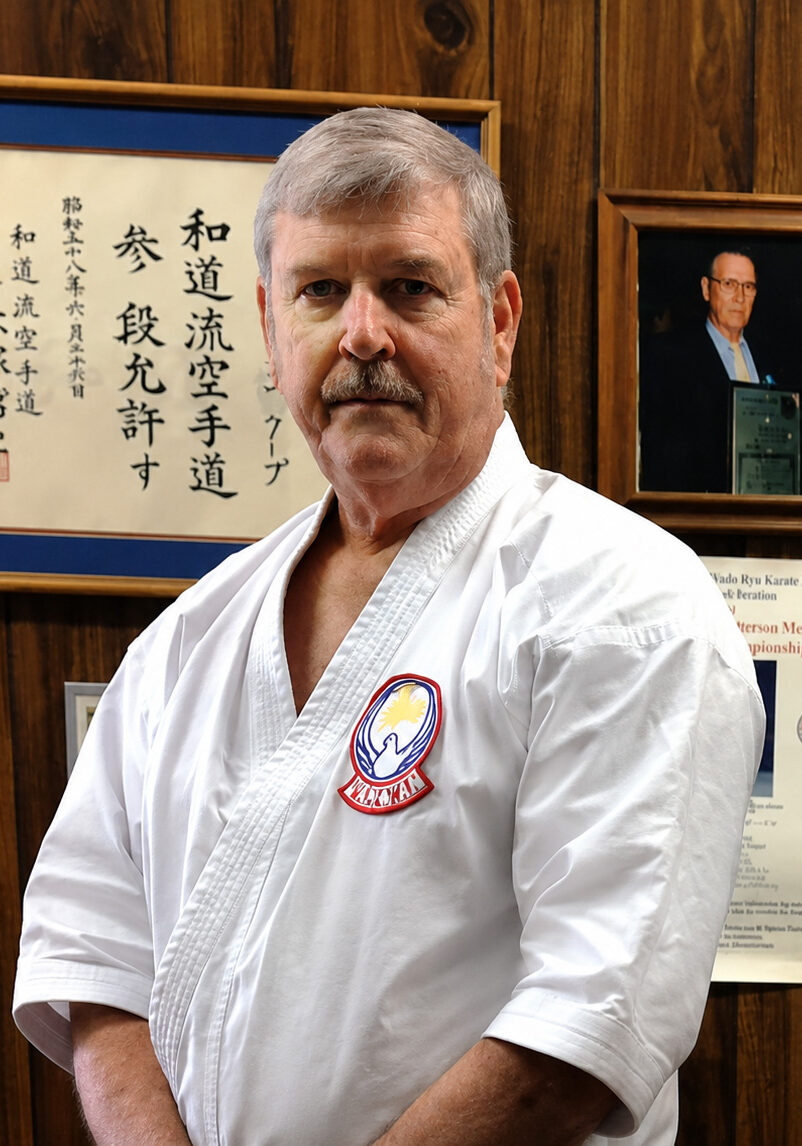
John V. Patterson
Current USEWF President
Following the foundational work of his father Cecil T. Patterson, John V. Patterson carried forward the principles and structure of Wado-Ryu Karate within the United States, helping to preserve its integrity while continuing its growth for future generations.
Trained within the lineage established by his predecessor, John V. Patterson emphasized the same core values that define Wado-Ryu: efficiency of movement, harmony over force, and the blending of body mechanics with timing and awareness. His teaching reflected a deep respect for the art’s Japanese roots while also recognizing the responsibility of adapting instruction to students in a modern American context.
As both an instructor and leader, he played a key role in:
- Maintaining continuity of Wado-Ryu curriculum and standards
- Supporting the development of instructors and black belts
- Strengthening the organizational structure of the federation
- Ensuring that the philosophical concept of “Wa” — harmony — remained central to training
John V. Patterson’s contribution is not only found in technique, but in stewardship. Through his efforts, students were not just taught how to perform Wado-Ryu, but how to embody it — with discipline, humility, and respect.
His place in the lineage represents a bridge between generations — honoring those who came before while equipping those who would carry the art forward.
From the founder Hironori Otsuka, through pioneers like Cecil T. Patterson, to the present leadership of Kazutaka Otsuka, Wado-Ryu Karate remains a living tradition—rooted in harmony, refined through generations, and carried forward with purpose.